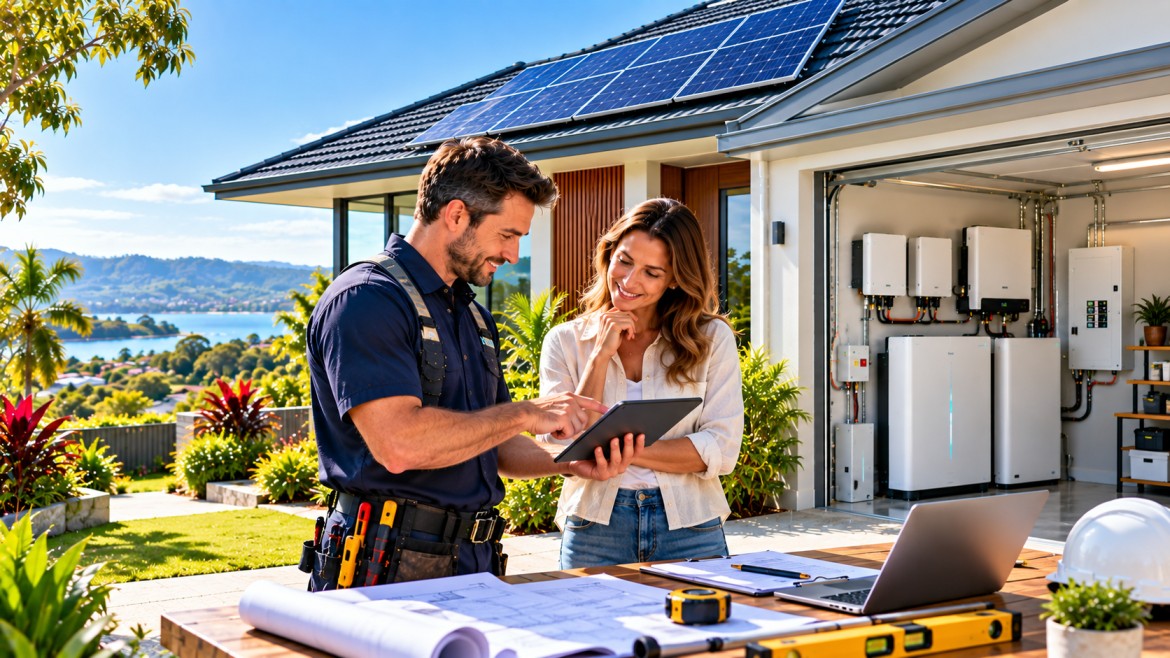
Choosing solar panels for a home or business is only one part of the process. The company designing and installing the system can have just as much influence on the final result.
A solar system needs to be properly matched to the property, electricity consumption, roof characteristics and future energy requirements. A well-designed installation can make better use of available roof space, while a poorly matched system may not deliver the performance a customer expected.
For homeowners and businesses comparing the best solar installer, there are several practical things worth checking before signing a contract.
1. Look for Proper Industry Accreditation
Solar is a technical industry, so accreditation and licensing should be among the first things a customer checks.
The Clean Energy Council has moved installer accreditation responsibilities to Solar Accreditation Australia, while the CEC continues to operate programmes covering approved products and consumer protection.
The Clean Energy Council’s consumer information explains how customers can check installer accreditation and find New Energy Tech Approved Sellers.
Accreditation does not replace careful research, but it provides an important starting point when comparing companies.
Customers should also ask who will actually carry out the installation and whether the electricians working on the property have the relevant qualifications.
2. Ask for a Site-Specific Assessment
A good solar installation should be designed around the actual property.
Roof orientation, shading, roof pitch, available space and electrical infrastructure can all influence system design.
The property’s electricity consumption is equally important.
A household that uses large amounts of electricity during the evening may have different requirements from a home with most of its energy demand during daylight hours.
For commercial properties, the design process can be more involved because businesses may have machinery, refrigeration, air conditioning, office equipment or other significant loads.
The Australian Government’s Solar Consumer Guide provides useful information about choosing solar and understanding the questions to ask before obtaining quotes.
A site assessment should therefore be more than simply looking at the roof.
3. Make Sure the System Is Designed Around Your Energy Use
One-size-fits-all solar packages can be convenient, but they are not necessarily suitable for every property.
A properly designed system should consider current electricity consumption and, where possible, future energy needs.
For example, homeowners may be planning to purchase an electric vehicle, install additional air conditioning or add a battery in the future.
Businesses may expect to increase operating hours, add equipment or expand their premises.
These plans can influence the appropriate system size.
The objective should be to design an energy solution that works with the way the property actually uses electricity.
4. Check the Quality of the Products
Solar panels, inverters and batteries are not interchangeable products.
Different manufacturers offer different specifications, warranties, efficiencies and features.
Customers should ask which brands and models are included in the quotation and why those products have been recommended.
The Clean Energy Council maintains approved product lists for relevant solar PV modules, inverters and battery products.
Checking approved products can be particularly important where government incentives or network requirements apply.
It is also useful to understand whether the installer has experience with the specific equipment being proposed.
5. Understand the Warranty
Solar systems are long-term investments, so warranty conditions deserve close attention.
There can be several different warranties involved in one installation.
These may include:
- Panel product warranty
- Inverter warranty
- Battery warranty
- Installation warranty
- Workmanship warranty
Customers should ask what each warranty covers and who is responsible if something goes wrong.
A long product warranty can sound attractive, but the practical value depends on the conditions attached to it.
It is also worth asking how warranty claims are handled and whether the installer assists customers with manufacturer claims.
6. Ask Who Will Install the System
The company that sells the solar system is not necessarily the company that physically installs it.
Some solar businesses use subcontractors, while others employ their own installation teams.
For customers, knowing who will be working on the property can make the process clearer.
Ask:
- Who will install the system?
- Are the installers licensed?
- Are they accredited?
- Are subcontractors used?
- Who is responsible for workmanship?
- Who handles problems after installation?
These questions can help customers understand where responsibility sits throughout the project.
Energy Solution Centre operates from Nerang on the Gold Coast and provides residential solar, commercial solar, battery storage, off-grid solutions and EV charging.
The company states that its installations are completed by in-house, CEC-accredited, licensed A-grade electricians rather than subcontractors.
7. Compare Complete Quotes
The cheapest solar quote is not automatically the best value.
Two proposals can have very different specifications even when their headline prices look similar.
When comparing quotes, look at:
- Solar panel brand and model
- Number of panels
- System capacity
- Inverter
- Mounting equipment
- Electrical work
- Monitoring
- Installation
- Warranty
- Switchboard requirements
- Future battery compatibility
For commercial solar, also consider system monitoring, access requirements, installation scheduling and how the project will affect business operations.
A detailed quote should make it possible to understand exactly what you are purchasing.
8. Consider Battery and EV Compatibility
Solar is no longer just about panels.
Many households are now considering batteries and electric vehicles as part of a broader energy strategy.
If you may install a battery later, ask whether the proposed solar system is suitable for battery integration.
Likewise, if you own or plan to purchase an EV, discuss home charging requirements with the installer.
Solar generation, battery storage and EV charging can work together, but the system needs to be designed appropriately.
The Clean Energy Council’s consumer resources now cover solar, battery storage and EV charging under its broader New Energy Tech Consumer Code framework. Its consumer guidance is useful for understanding the questions customers should ask before purchasing new energy technology.
9. Look Beyond Installation Day
Solar installation is not the end of the customer relationship.
A good system should be supported by appropriate monitoring, documentation and after-sales assistance.
Ask what happens if:
- The inverter reports an error
- Monitoring stops working
- A panel develops a fault
- The system produces less energy than expected
- A warranty claim is required
- You want to add a battery later
Ongoing support can become especially important as a system gets older.
This is one reason local businesses can be attractive to homeowners and businesses that value having a physical point of contact.
Why Solar System Design Matters
The quality of the design can influence the usefulness of the entire installation.
For example, two homes with identical roof areas may require different systems because their electricity consumption patterns are different.
One household might have high daytime usage, while another may consume most of its electricity after work.
The same principle applies to commercial properties.
A business operating during daylight hours may be able to use a large proportion of its solar generation directly. A business with significant evening consumption may have different requirements and could benefit from considering storage.
Good system design begins with understanding how energy is used.
Solar for Homes, Businesses and Rural Properties
Solar requirements can also vary considerably depending on the type of property.
Residential systems are often designed around household electricity consumption and roof availability.
Commercial solar may involve larger arrays, three-phase electrical systems, greater daytime loads and more complex installation requirements.
Rural properties may have additional considerations such as pumps, sheds, workshops and, in some cases, the possibility of operating off-grid.
This is why experience across different types of solar projects can be useful when comparing installers.
What About Batteries?
Battery storage can allow excess solar energy generated during the day to be stored for later use.
For some households, this can increase the amount of solar energy consumed on-site rather than exported to the grid.
Battery systems can also be configured for backup power, depending on the equipment and installation design.
However, homeowners should not choose a battery simply because it is available as an add-on.
The battery should be sized according to electricity consumption, solar generation and the household’s specific objectives.
Australia’s Solar Market Continues to Develop
Australia’s rooftop solar market has expanded significantly, while battery storage is becoming increasingly important.
Recent ABC News reporting highlighted the rapid growth of household batteries and their increasing role in Australia’s electricity system.
That broader shift means consumers have more technology choices than ever before.
It also makes careful comparison more important.
Final Thoughts
Choosing the best solar installer is about much more than finding a company that can put panels on a roof.
Customers should consider accreditation, site assessment, system design, product quality, warranties, installation practices, future battery compatibility and after-sales support.
The right installer should be able to explain why a particular system is suitable for the property rather than simply presenting a standard package.
For homeowners and businesses considering solar on the Gold Coast, taking time to compare complete proposals can help create a clearer understanding of what is being purchased and how the system is expected to perform.
FAQs
What should I look for in the best solar installer?
Look at accreditation, licensing, site-specific design, product quality, warranty conditions, installation practices, customer support and experience with systems similar to yours.
Should a solar installer visit my property?
A site-specific assessment can help identify roof, shading, electrical and installation considerations that may not be obvious from an online quotation.
Is the cheapest solar quote the best option?
Not necessarily. Compare the complete system, including equipment, installation, warranties, monitoring and support.
Can I add a battery to my solar system later?
In many cases, yes, but compatibility depends on the solar system and equipment. It is useful to discuss future battery plans before the initial installation.
Does Energy Solution Centre install commercial solar?
Yes. Energy Solution Centre provides commercial solar solutions as well as residential and off-grid systems.